On the evening of September 12, Mount Bromo was once again fully closed because of a forest fire, with the reopening date yet to be determined. This was the second closure since August. The previous closure began on August 8 and lasted until August 20. Hundreds of kilometers away, Mount Ijen has remained closed since September 4 because of a fire.
The two volcanoes are merely a microcosm of the broader situation. As of mid-September, more than 200,000 hectares had burned across six major regions of Indonesia, and forest-fire carbon emissions had risen to the highest level globally. In the first week of September alone, emissions reached 19.7 million tonnes, accounting for more than one-third of the global total.
In 2015, a forest fire of similar scale burned nearly 30% of APP's (Asia Pulp & Paper, part of the Sinar Mas Group) pulpwood plantations in South Sumatra. The fire occurred on the eve of the start-up of the first phase of the OKI pulp mill, one of the world's largest single-site pulp mills, with a designed capacity of 2 million tonnes per year. The capacity ramp-up was consequently delayed for several years.
Goldman Sachs recently urged close monitoring of Indonesia's forest fires, noting that fire-related emissions are approaching the record level seen in 2015.
But two more specific questions need to be answered after that 'monitoring': Can Indonesia's supply reduction be replaced elsewhere? And how long did pulp prices take to react after 2015?
Without clear answers to these questions, the black-swan argument does not hold.
Burned area may be underestimated: peatland hotspot density has already exceeded the level seen in the same period of 2015
Based on cumulative burned area, Indonesia's national burned area from January through July 2026 was about 202,000 hectares, according to data from Indonesia's forestry authorities—only about one-third of the roughly 600,000 hectares recorded during the same period in 2015. Judging solely by this indicator, the impact of the current fires appears far less severe than in 2015.
However, burned area is a lagging indicator: it reflects land that has already been burned. Hotspot density is a leading indicator, pointing to the momentum of fire spread. According to monitoring data from the independent organization Pantau Gambut (Peatland Watch), In August 2026 alone, the number of fire hotspots detected in Indonesia's peatlands surged from about 45,000 to more than 160,000, an increase of over 250%. Between August 1 and September 8, 13,443 hotspots were detected in key peatland monitoring areas, compared with 9,454 during the same period in 2015. The organization's year-on-year comparison shows that daily hotspot density in key peatland monitoring areas in 2026 has already surpassed the level seen in the same period of 2015.
This divergence has clear implications for the industry. Peatlands are the most dangerous fuel source in Indonesia's wildfires. Naturally waterlogged peat becomes a highly combustible underground fuel reservoir once it is drained for plantation development. Fires can spread into deeper layers; even after the surface is extinguished, the underground fire can continue to smolder and may reignite at any time. The reason the 2015 fire expanded from 600,000 hectares in the first half of the year to 2.6 million hectares for the full year was largely the loss of control over peatland fires. According to post-fire statistics from Indonesia's Ministry of Environment and Forestry, 2.6 million hectares burned in 2015, of which about 14% was forested land; 50% of the burned forested area was industrial plantation forest.
The weather conditions facing Indonesia in 2026 are almost a repeat of 2015: an exceptionally strong El Niño, prolonged drought, and almost no rainfall across more than 90% of the country in early August. Indonesia's meteorological authorities have warned that El Niño may persist into early 2027 and peak between December 2026 and January 2027. Carbon-emissions data further support this assessment: by September 7, Indonesia's forest fires had generated 76.2 million tonnes of carbon emissions, following a trajectory highly similar to 2015, when full-year emissions reached 333 million tonnes. This data comes from the Global Fire Emissions Database, as published by Carbon Brief.
Three conditions are present simultaneously: peatland hotspot density has exceeded the level of the same period in 2015, weather conditions are highly similar, and the peak of the dry season has not yet passed. This means the risk of further fire expansion remains and should not be underestimated simply because the current burned area is relatively low.
Wildfires are raging in the heart of the pulpwood supply region
For the impact of forest fires on pulp supply, the key issue is not the total burned area but the degree of geographic overlap between high-risk fire zones and pulpwood production capacity.
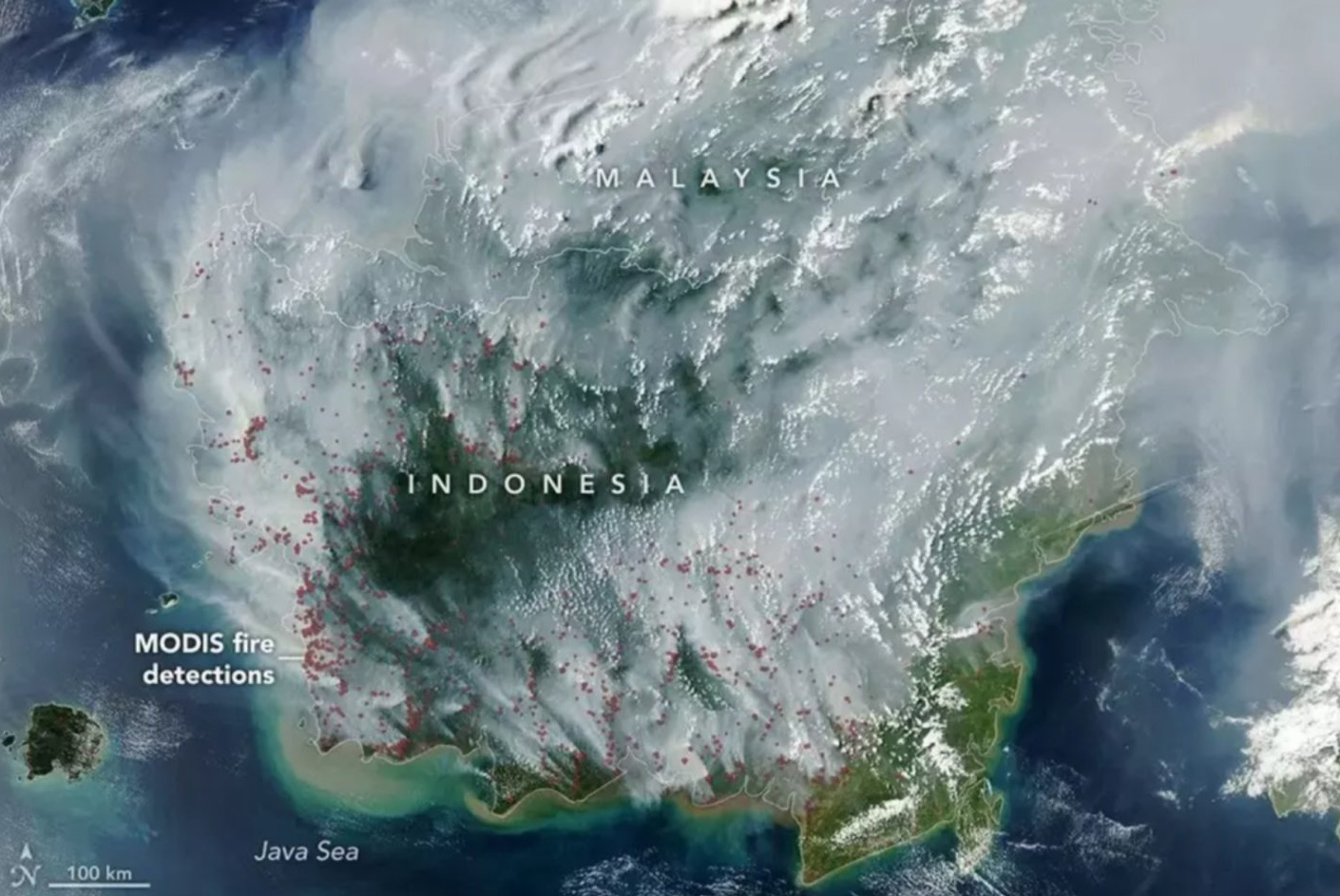
According to data from the independent forest-monitoring platform Nusantara Atlas, in Kalimantan from January through July 2026, three of the ten companies with the most severely affected wildfire areas in their concessions were pulpwood companies. Among them, PT Hutan Ketapang Industri, a pulpwood supplier held by Singapore-based Sampoerna Agri Resources, had 629 hectares of forest burned within its concession. During the same period, approximately 10,500 hectares of Indonesia's pulpwood plantations were burned nationwide, ranking third after palm-oil plantations and mining concessions.
Even more noteworthy is the recurrence of fires: at least seven of the ten companies mentioned above had fires in their concession areas in 2006, 2015, and 2023. This reveals a structural problem: Indonesia's core pulpwood plantation areas have long been located in high-fire-risk zones, with the same areas repeatedly affected. Indonesia contains about 36% of the world's tropical peatlands, while pulpwood plantations—mainly acacia and eucalyptus—are heavily concentrated in peatland-rich areas.
Entering August, the fire situation did not ease. An analysis by WALHI (Indonesian Forum for the Environment), based on the same platform's data, showed that PT Hutan Ketapang Industri remained among the companies continuously affected by fires. That month, about 25% of all peatland hotspots nationwide were located within commercial concession areas. Nusantara Atlas estimated that by late August, Indonesia's total burned area had approached 900,000 hectares, far above the official figure of 202,000 hectares for the same period.
Since September, the fires have continued to spread. The Global Disaster Alert and Coordination System recorded 5,024 hectares burned in Indonesia during the first week of September alone. The Indonesian government has explicitly stated that September will be the most critical month this year for extinguishing wildfires.
In aggregate terms, losses to pulpwood plantations remain manageable; geographically, however, the overlap between fire concentration zones and core pulpwood supply areas means that if the fires intensify further, the transmission path to production capacity is very short.
23% of China's hardwood pulp comes from Indonesia, while all alternative supply sources face constraints
To assess the impact of Indonesia's forest fires on pulp supply, we must return to a more fundamental question: how much pulp does China import, how important is Indonesia, and can other sources replace Indonesia's supply after a reduction?
According to data from China's General Administration of Customs, China's total pulp imports were approximately 36.04 million tonnes in 2025, with an import value of RMB 156.555 billion, up 4.9% year on year. More than 60% of China's pulp demand depends on external supply; import dependence exceeds 95% for softwood pulp and is about 60% for hardwood pulp. Any supply fluctuation in a major hardwood-pulp supplier will directly affect China's raw-material costs and the profitability of finished paper.
Indonesia's position in hardwood pulp is more important than many people realize. In 2025, the four largest sources of China's bleached hardwood pulp were Brazil, Indonesia, Uruguay, and Chile, with imports of 9.2 million, 3.48 million, 1.8 million, and 1.68 million tonnes, respectively, accounting for 54%, 21%, 11%, and 10%. Brazil and Indonesia together accounted for 74%. The share is still increasing: in the first half of 2026, China imported 1.96 million tonnes of hardwood pulp from Indonesia, up 15% year on year, raising Indonesia's share to 23%, while China's total hardwood-pulp imports were flat year on year. About 75% of Indonesia's pulp exports go to China, creating a deeply integrated vertical relationship between the two sides.
So, can Indonesia's reduction be replaced elsewhere?
China's total wood-pulp imports also come from Russia, Canada, Finland, and other countries, but these countries mainly supply softwood pulp and do not have the capacity to substitute for Indonesia in hardwood pulp. Each potential replacement route faces significant constraints, making effective short-term substitution difficult.
Brazilian expansion: too far away to solve the near-term shortage. Brazil is the world's largest marginal source of hardwood pulp and accounted for 54% of China's hardwood-pulp imports in 2025. However, the window for large-scale new capacity in Brazil has closed. From 2022 to 2024, Brazil went through a 'super expansion cycle' for hardwood pulp, releasing more than 6 million tonnes of capacity in total. No comparable volume of new capacity is expected to come onstream in 2026. Arauco's 3.5-million-tonne-per-year Sucuriú project is not expected to reach full production until 2028. More importantly, Brazil itself is reducing supply. Suzano announced that it would cut market-pulp production by 3.5% in 2026, reducing annual output by more than 450,000 tonnes, equivalent to about 1% of global hardwood-pulp supply. Brazil is not filling Indonesia's gap; it is reducing output alongside Indonesia.
Uruguay and Chile: insufficient scale and frequent maintenance. The two countries together account for about 21% of China's hardwood-pulp imports, but their combined hardwood-pulp capacity is below 10 million tonnes and they have no large-scale expansion plans. In the first quarter of 2026, Suzano carried out maintenance on 5.35 million tonnes of hardwood-pulp capacity, while CMPC maintained 2.38 million tonnes of capacity. South American supply contracted in the first half of the year rather than expanding.
Chinese domestic pulp: incremental output is absorbed internally, leaving limited volumes for external sale. China's domestic wood-pulp production is growing rapidly, but the increase mainly comes from integrated pulp-and-paper projects with very high internal-use ratios. Chenming Paper's pulp capacity is 4.3 million tonnes; apart from 600,000 tonnes at its Huanggang base, which is mainly sold externally, the other bases are entirely for internal use. New pulp lines at leading companies such as Liansheng, Nine Dragons, and Sun Paper also mostly feed their own paper-production lines directly. The increase in domestic pulp offsets the import volumes these companies previously required, rather than increasing the amount of merchant pulp available on the market. For small and medium-sized paper mills without captive pulp lines, dependence on imported market pulp remains, so the impact of an Indonesian supply reduction is direct.
Taken together, the conclusion is clear: in 2026, there is no 'replacement supplier' in the global hardwood-pulp market capable of absorbing an Indonesian supply reduction.
After the 2015 forest fires, prices took more than a year to complete their repricing
The relationship between the 2015 forest fires and the first phase of the OKI mill cannot be reduced to 'plantations were burned'; the key question is what happened to prices after the fires.
November–December 2015: pulp prices did not rise because of the fires. After long- and short-fiber pulp prices were reduced in November 2015, short-fiber pulp prices fell further in December. The reasons were multifaceted: weak global economic conditions kept the pulp-and-paper market soft, inventories increased, and support for both long- and short-fiber pulp prices was weak. At the time, Indonesia's TEL company shut down its 480,000-tonne pulp mill, while Asia Symbol carried out maintenance on a 1.5-million-tonne pulp line, but the supply contraction was insufficient to overturn the dominant logic of weak demand.
Second half of 2016: pulp prices began to move. The real turning point came in the second half of 2016. From then on, pulp-market conditions improved under the combined influence of RMB depreciation, continued increases in international wood-pulp prices, and domestic supply-demand imbalances. During the previous supply-side reform cycle from 2015 to 2017, the industrial-goods index rebounded as early as January 2016, while finished-paper prices did not begin rising until the second half of the year. Industry-chain profits were initially driven by pulp prices and later transmitted back toward the pulp end as finished-paper prices increased.
2017–2018: pulp prices rose 60% within a year. The loss of wood supply caused by the 2015 fires gradually became evident in APP's pulp output in 2016. At the same time, China's paper industry experienced a major rise in finished-paper prices in 2017 driven by environmental production restrictions, directly boosting wood-pulp demand. Pulp prices rose 60% from their lows over the year through the first half of 2018.
The key lesson from 2015 is that the impact of forest fires on prices was not immediate. It unfolded gradually over more than a year through the chain of 'loss of wood supply, decline in mill output, inventory drawdown, insufficient supply elasticity when demand recovered, and price repricing.' The price turning point occurred more than a year after the fires.
Transmission has already begun in 2026, with the cost center gradually moving higher
Mapping the 2015 transmission pattern onto 2026, the market may now be closer to the eve of a turning point than many people think, although the pace and ultimate magnitude of the transmission still need to be monitored.
In 2026, the combination of forest fires and revoked forestry permits is equivalent to the initial shock to wood supply caused by the 2015 fires, but the policy variable is stronger. In January, the Indonesian government revoked the forest concessions of 22 forestry companies, covering about 1 million hectares of plantation forests mainly planted with acacia and eucalyptus. APRIL announced that it would reduce BHK pulp supply from its Kerinci mill by about 150,000 tonnes in the first quarter of 2026; after accounting for scheduled maintenance, the effective supply reduction was about 122,000 tonnes.
APP's OKI Phase II, a new 1.4-million-tonne-per-year BHK production line originally scheduled to start in June 2026, has now been postponed to the end of 2026 or early 2027. Fastmarkets, in its March 2026 report 'Global Pulp Outlook 2026,' noted that the supply originally expected to enter the market in June would now be absent until the end of the year or early 2027.
Transmission to costs has already begun. The same Fastmarkets report estimated that tighter Indonesian wood-chip supply had pushed up China's imported wood-chip prices, increasing China's BHK production cost by about US$50 per tonne. More upside may emerge as energy-related surcharges are implemented. Galaxy Futures summarized the effects as follows: forest fires combined with tighter forestry policies are raising the hardwood-pulp cost center through higher Southeast Asian wood-chip costs, and delays to projects expected to come onstream.
Unlike 2015, 2026 also includes a contraction in global softwood-pulp capacity. Canfor officially announced on July 15, 2026 that it would permanently close the Northwood pulp mill, cutting 300,000 tonnes per year of NBSK capacity, with shutdown expected to be completed by the end of 2026. Domtar announced on August 20 that its Howe Sound softwood-pulp mill would be idled indefinitely, reducing bleached softwood-pulp supply by 380,000 tonnes per year. From 2022 through the first half of 2026, nearly 3 million tonnes of global softwood-pulp capacity had exited the market.
Based on the current market situation, as of September 10, the sample inventory of mainstream pulp ports in China stood at 2.263 million tonnes, down 29,000 tonnes from the previous period, but the absolute level remained in the medium-to-high range for the year. The current inventory drawdown reflects phased purchases rather than a substantive recovery in end-user demand.
In futures markets, the front-month pulp contract has fluctuated in the range of RMB 4,700–4,800 per tonne. Downstream paper mills are maintaining purchases for immediate needs rather than stocking up in advance. Guosen Futures' assessment is that the core pressure keeping prices weak is that demand has not shown a meaningful recovery, while overall supply remains relatively ample.
This pricing structure means the market is trading current inventories and spot demand, while supply-side changes are laying the groundwork for the 2027 balance sheet. As higher wood-chip costs caused by forest fires, supply reductions resulting from revoked forestry permits, Suzano's 450,000-tonne production cut, and the delay of OKI Phase II all affect the hardwood-pulp cost curve, the upward shift in the cost center may be more certain than current market pricing suggests, although the pace and magnitude still need to be monitored.
The impact of Indonesia's forest fires on pulp supply is more likely to emerge as a gradual upward shift in the cost center rather than a short-term supply disruption.
The impact of this slow-moving variable on the industry chain still needs to be monitored in conjunction with subsequent fire conditions, policy developments, and changes in overseas production capacity.