The final vessel in a series of multi-purpose pulp carriers built by Dalian COSCO Shipping Heavy Industry Co., Ltd. — the GREEN GUANGZHOU — was officially named on the 14th in Dalian, Liaoning, and will soon be delivered to the shipowner. The naming ceremony marks the completion of all 50 pulp carriers ordered since 2017, fulfilling the entire construction program undertaken by Dalian COSCO Shipping Heavy Industry.
As a type of high-end special-purpose vessel, pulp carriers require exceptionally high standards for cargo-hold sealing, environmental protection, and multi-cargo compatibility — a market segment long dominated by foreign shipbuilders. In 2017, Dalian COSCO Shipping Heavy Industry secured an order for 50 multi-purpose pulp carriers, the largest series of professional pulp-transport vessels in the global market to date.

The GREEN GUANGZHOU has an overall length of 225.00 meters, a molded beam of 32.26 meters, a molded depth of 21.00 meters, and a design speed of 15 knots. The vessel's cargo hold features excellent sealing and dehumidification performance, ensuring maximum safety and quality protection of pulp cargo during transport. In addition to pulp, the ship is also capable of transporting high-speed trains, wind-power equipment, large machinery, and ultra-long or ultra-heavy steel pipe piles, demonstrating outstanding cargo-adaptability.
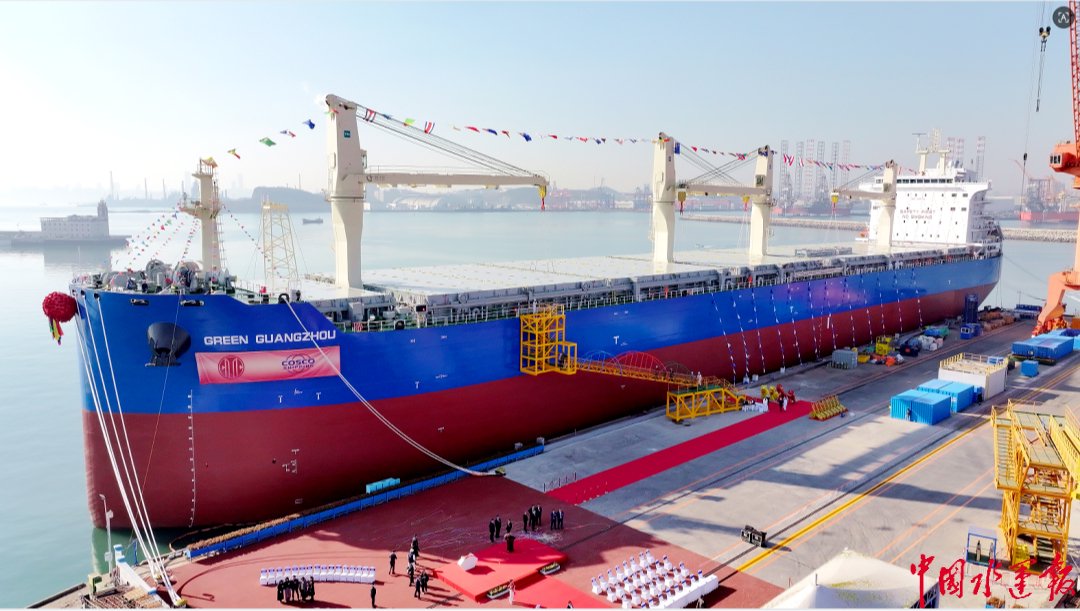
To meet the logistics needs of the booming export of electric vehicles, the vessel has been specially upgraded with a “foldable vehicle-carrier framework” and is equipped with a temperature-monitoring and early-warning system customized for new-energy vehicles.
According to Shao Xiaobin, General Manager of Dalian COSCO Shipping Heavy Industry, the completion of the 50-vessel program reflects nearly nine years of technological iteration. The series has evolved from 62,000-ton and 68,000-ton vessels to 77,000-ton and 85,000-ton classes. Meanwhile, their operational capabilities have expanded from “professional pulp transport + general breakbulk cargo + bulk cargo” to a composite mode of “automobile + container transportation.” This not only supports the core demand for exporting China’s high-end equipment and transporting bulk commodities, but also exports Chinese shipbuilding standards and service capabilities to the world.